Research - Emerging Urbanism In Palghar

Sem 9
Topic Of Research - Spatial Transformation in House Forms In Peri - urban Regions - A case Of Tembhode In Palghar District
ABSTRACT
This research focuses on the shifts occurring due to the rapid urbanization of peri-urban areas like Palghar, which has seen significant infrastructure and development growth since 2014. As per the District Strategic Plan for Palghar 2023, a report by IIT Bombay and YASHADA, major economic and infrastructural developments, along with ongoing mega projects, have led to a rise in residential buildings and public infrastructure, contributing to population growth and a rapidly transforming landscape across the Palghar district.The study identifies Tembhode, a village in Palghar, as the site of inquiry, where rural settlements now coexist with new constructions on former agricultural land. This transition reflects the village’s transformation from an agrarian economy to one shaped by emerging urban and economic forces. The village accommodates both local residents and a mixed community of migrants and outsiders, who live together while negotiating boundaries and relationships within this changing context. These dynamics can be observed and documented through the spatial patterns of transformation from agrarian landscapes to newer emerging built environments. The research specifically examines shifts in local households, reflected in evolving housing typologies, land-sharing practices, and changing aspirations.The study further involves documenting the village through overall observations as well as individual household stories and interviews to understand the economic and spatial transformations. This research aims to reveal the patterns of change and the nature of shifts in house forms occurring under the influence of economic and social structures.
INTRODUCTION

Palghar district, located in the northern part of the Konkan division of Maharashtra, lies about 87 km north of Mumbai and forms part of the Mumbai Metropolitan Region, while still retaining a strong rural and coastal identity. It is the 36th district of the state, carved out of Thane on August 1, 2014, and its history remains closely linked to that of Thane, with continuing economic competition across various sub-sectors. The district’s growth strategy, however, depends largely on leveraging its locational advantage and improving accessibility through several mega infrastructure projects currently under implementation. This growing infrastructural network has significantly influenced Palghar’s shift from an agrarian-based economy toward an urbanizing district driven by real estate and industrial expansion. The report also notes Palghar’s emerging role as an affordable housing destination, with property prices considerably lower than those in the Vasai–Virar belt and the broader MMR, encouraging migration and new residential development. These transformations collectively underline Palghar’s transition into a peri-urban extension of Mumbai where increasing accessibility, investment potential, and spatial restructuring are redefining both its economic base and settlement patterns, leading to a continuous process of transformation.
ARGUMENT
Problem Statement
In peri-urban areas like Palghar, where I have lived since my childhood, I have observed and experienced shifts in housing typology. Since 2014, when Palghar was announced as a district, rapid emerging urbanism has been transforming both life and landscape, with a shift from agricultural land to residential apartments. This transformation has affected the lives of locals and migrant communities, creating hard boundaries between houses and buildings, and bringing incremental shifts in housing types in response to the emerging urbanism and its spatial use of space.
Research Question
How is an emerging urbanism shaping the spatiality of house forms and life of locals as well as migrant communities in periurban locations? Research Aim To think of contemporary sustainable forms of inhabitation for local inhabitants as well as migrants amidst emerging processes of urbanization.
Research Objective
• To identify and document the houses, living patterns, and land use of multiple and indigenous communities.
• To analyse the historical shift from agricultural land to residential land and the resulting changes in the use of space.
• Identifying new forces in emerging urbanism.
• To study a series of transformations of old houses in response to the newer emerging context.
• To locate patterns in the spatial shifts and their relationship to new forms of life.

LITERATURE STUDY
Urbanism is broadly understood as the study of how populations in urban areas, such as towns and cities, interact with the built environment, while urbanization refers to the process of development and growth of urban areas. Often, urbanization is perceived as a purely physical expansion of cities and is frequently viewed as having negative impacts on local communities due to rapid contextual changes. However, readings and research have opened up new perspectives, allowing me to see urbanization not only as a disruptive force but also as a process that brings social and cultural transformations to which communities adapt in multiple ways. Christian Schmid, in Towards a New Vocabulary of Urbanisation Processes, argues that urbanization should not be understood merely as city growth but as a complex, evolving process shaped by both local histories and global forces. He highlights that it transforms territories and ways of life in diverse, context specific ways. This framework helps me shift my understanding of urbanization in Palghar from a problem or negative force to a complex process that reshapes and transforms local communities in specific ways, creating both challenges and opportunities. Carolyn Stephens, in The Indigenous Experience of Urbanization (The Indigenous World 2015), similarly explores how urbanization affects indigenous identities, community ties, and cultural continuity. Rather than framing urbanization solely as displacement or loss, she emphasizes resilience and adaptation. This lens allows me to interpret peri-urban transformation as not only a challenge to local practices but also as a space where cultural adaptation and continuity coexist with development, showing how people actively negotiate their identities in changing contexts. At the scale of households and settlements, M. F. Ahamed in Indigenous Group: A Study Through Spatial Perspective examines how spatial perspectives reveal the relationship between indigenous groups and their environments. His work highlights how culture, traditions, and livelihoods are intertwined with spatial organization, showing how housing typologies and settlement patterns evolve through both cultural continuity and adaptation to emerging opportunities. This insight strengthens understanding of Palghar, where newer housing forms, land-sharing practices, and shifting aspirations are reshaping the lived environment. Building on these readings, my research uses this literature to frame the transformations in Palghar not merely as outcomes of urban expansion but as negotiations between livelihoods, emerging economies, and spatial adaptation. By analyzing how economic shifts, housing typologies, social relations, and house forms reflect both change and transformation, the study positions Palghar’s evolution within broader discourses of urbanism and local adaptation. Rather than viewing these changes as negative impacts on local communities, the research approaches them as opportunities to identify and understand the emerging economic and social layers shaping new ways of living and inhabiting within the region.
FIELD OF STUDY
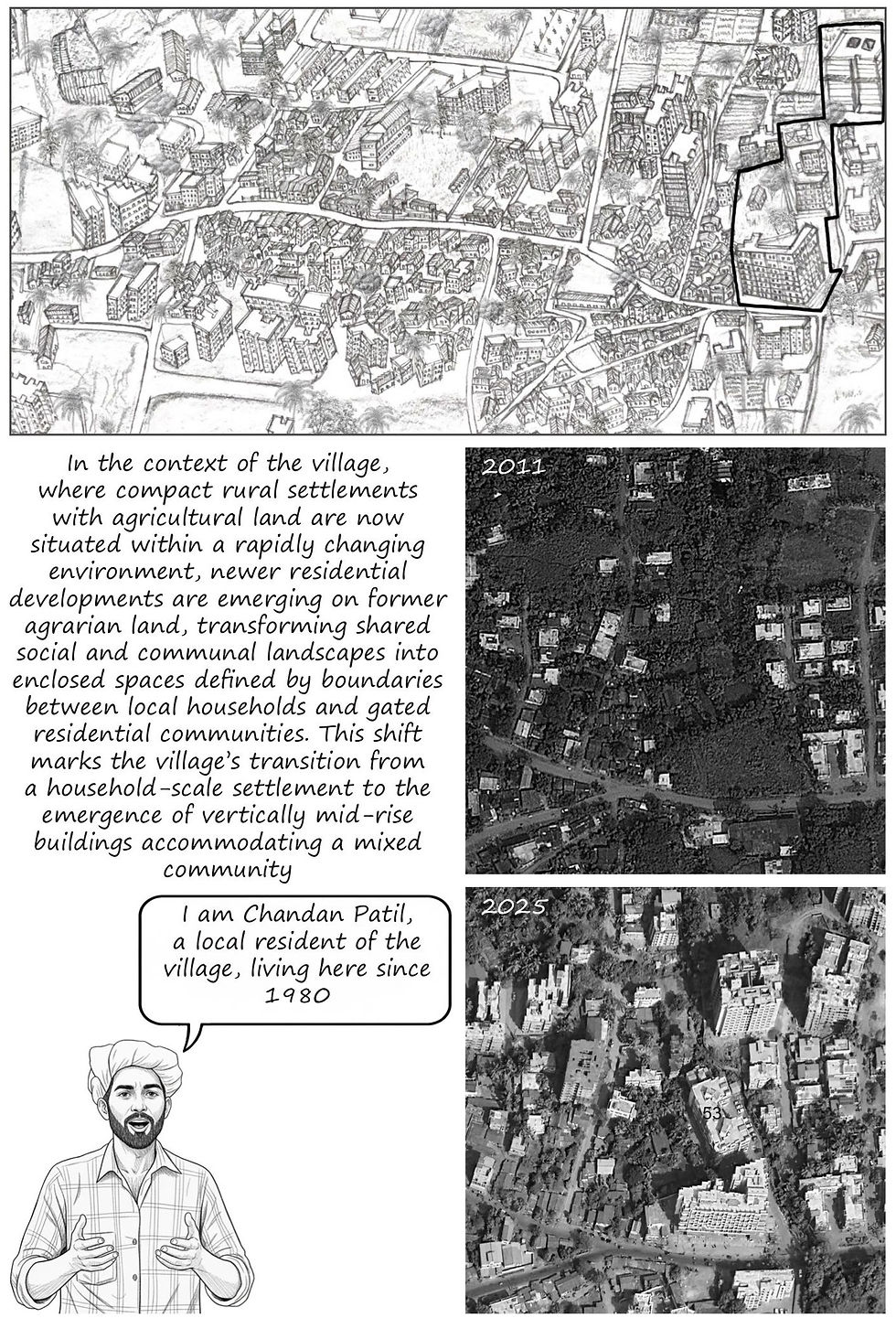
Tembhode, located in Palghar West about 2 km from the Palghar railway station, is a village spread across approximately 145 acres. It consists of compact rural settlements with agricultural land now situated within a rapidly changing context, where new developments are emerging on former agrarian plots. The village is inhabited by both locals and a growing mixed community of migrants, together shaping evolving social and spatial relationships. As per the 2020 population data, Tembhode has a population of 6,294, comprising 3,300 males and 2,994 females, spread across an area of approximately 3.46 square kilometers. The primary local groups include the Agri and Kohli communities, who, along with migrant populations, are gradually shifting towards cities in search of better employment and educational opportunities. Once dependent on agriculture, the village is now transitioning towards a newer economy driven by changing aspirations and urban influences. This shift is reflected in the transformation of housing types and the emergence of new neighborhood patterns. Incrementally expanded village houses have also created opportunities for migrant families, mostly from Bihar, Uttar Pradesh, and Madhya Pradesh, who have moved to Palghar seeking better livelihoods in sectors such as construction, painting, labor work, and small industries. Known for its affordable housing, Palghar allows these migrants to rent homes in the village at relatively lower costs. This evolving rental economy marks a significant shift for local residents, representing a move away from agrarian-based livelihoods toward new forms of economic adaptation shaped by the emerging urban context. Over time, this shift has also evolved into a financial model that supports both pilgrimage activities and the development of residential and row houses, marking a significant transformation in the village’s economy.

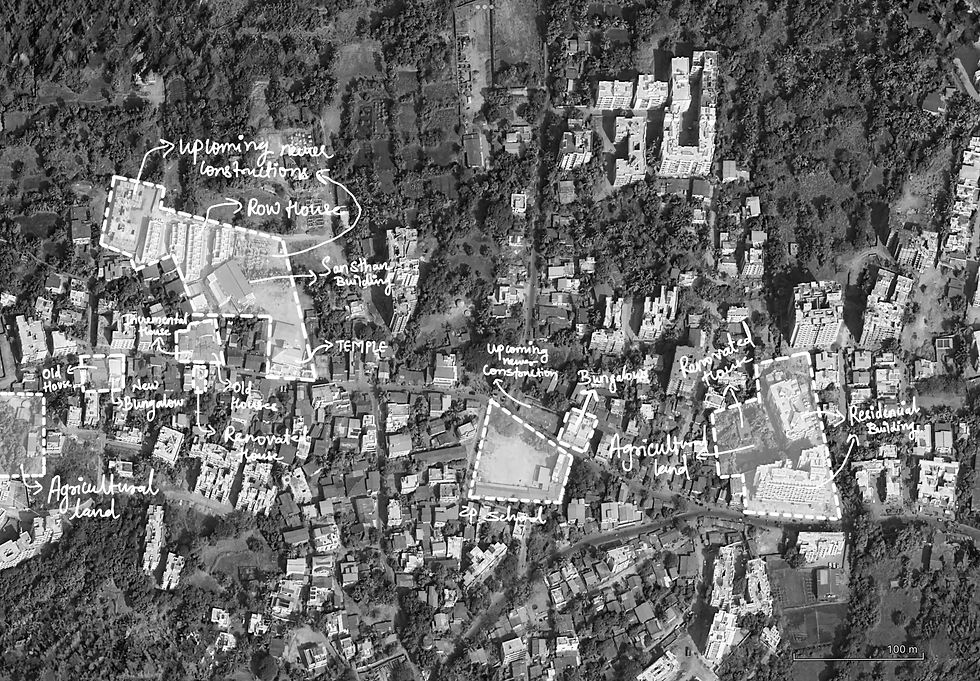
Transformations in the village’s overall context

Identification of Cases

FIELDWORK
Case 1 – Old Agrarian House Type (1920)
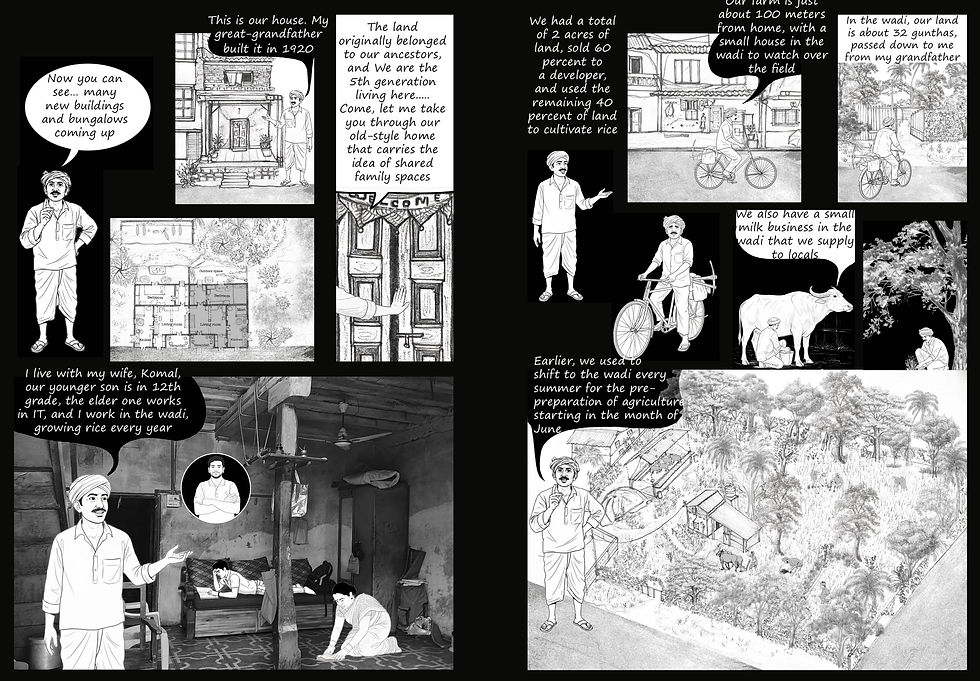
Kishor Patil, a fifth-generation resident of Tembhode village, lives with his wife Komal and two sons in their ancestral house built in the 1920s by his great-grandfather, constructed with wooden columns, mud walls, and Mangalore tiled roofing, representing the old agrarian house type rooted in communal and shared living, with a large hall featuring a central wooden pillar (Brahma Khambh), a loft (mala) for storage, an elongated kitchen with separate cooking and washing areas (chulha ani mori), and a semi-open backyard with an outdoor chulha and bathing space that together reflect a lifestyle centered on collective family living and agricultural routines, while the family, once owning 2 acres of farmland nearby for rice cultivation and cattle rearing, sold 60% of it for residential development as agriculture declined, retaining 40% (about 32 gunthas) for continued rice farming, marking a gradual shift in the agrarian economy.

Case 2 - Renovated House Type Responding to Changing Family Structures (1985)

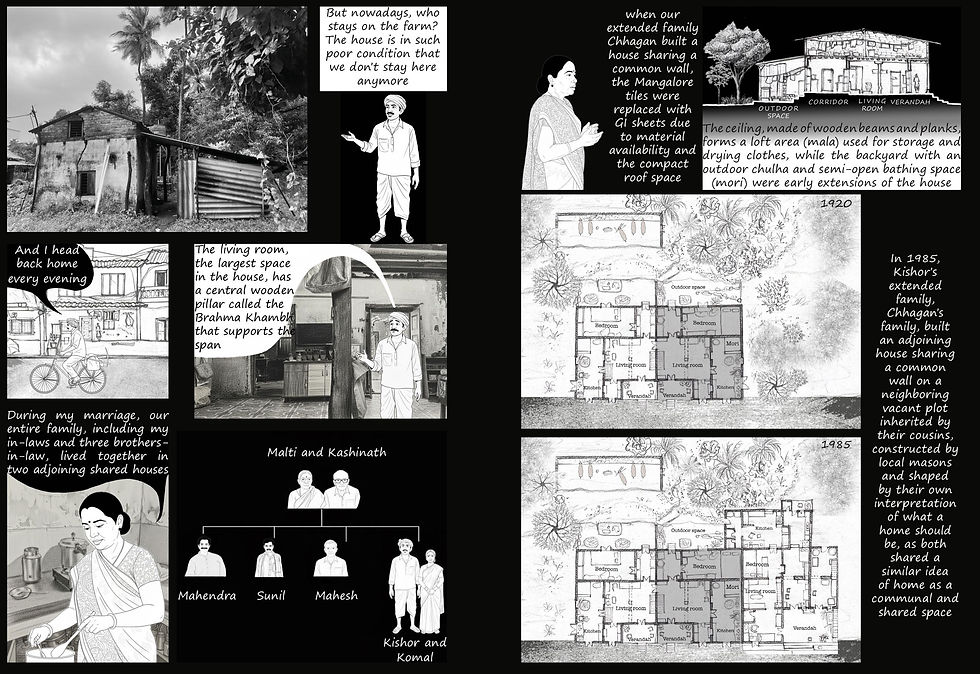
Built in 1985 beside Kishor Patil’s ancestral home, Sujata and Chhagan Patil’s renovated house reflects how changing family structures influenced both spatial and material transformations, as the house’s horizontal expansion, driven by family growth, was constructed by local masons using a combination of traditional and newer materials such as GI sheets replacing Mangalore tiles. The layout retains the agrarian home logic of a verandah and linear rooms but adapts with furniture partitions, a step-down kitchen, and a loft (mala), marking the transition from communal to semi private living, while the family’s move from small-scale farming to salaried and service-based work, Sujata as a teacher, Chhagan as a yoga instructor, and their engineer son, captures the broader social and economic shift from agrarian livelihoods to education driven professional occupations, leading to a transformation in house form from the agrarian old type to a renovated house in terms of its spatial layout.


Case 3 - Redevelopment of Old Agrarian House Type into Apartment Form (2010)
In 2010, Kishor Patil’s three brothers redeveloped their old agrarian shared neighboring house into a three-storey apartment-style building, each floor occupied by one family unit, marking a transformation in both materiality and housing type. Built at a cost of around 45 lakhs by a local contractor, the new RCC structure replaced the older tiled-roof homes and featured standardized layouts with separate living, kitchen, and bedroom spaces designed around the idea of privacy. This vertical expansion not only introduced independence within the extended family but also reflected changing economic aspirations, Mahendra Patil’s shift to the construction industry, Mansi Patil’s teaching career, and the younger generation’s pursuit of higher education and salaried work. These shifts illustrate how evolving ambitions and access to new opportunities redefined the family’s house form, livelihoods, and their relationship with the agrarian economy, transitioning toward more nuclear and aspiration-driven living.


Case 4 - Emergence of New Row Houses and Gated Communities (2020)
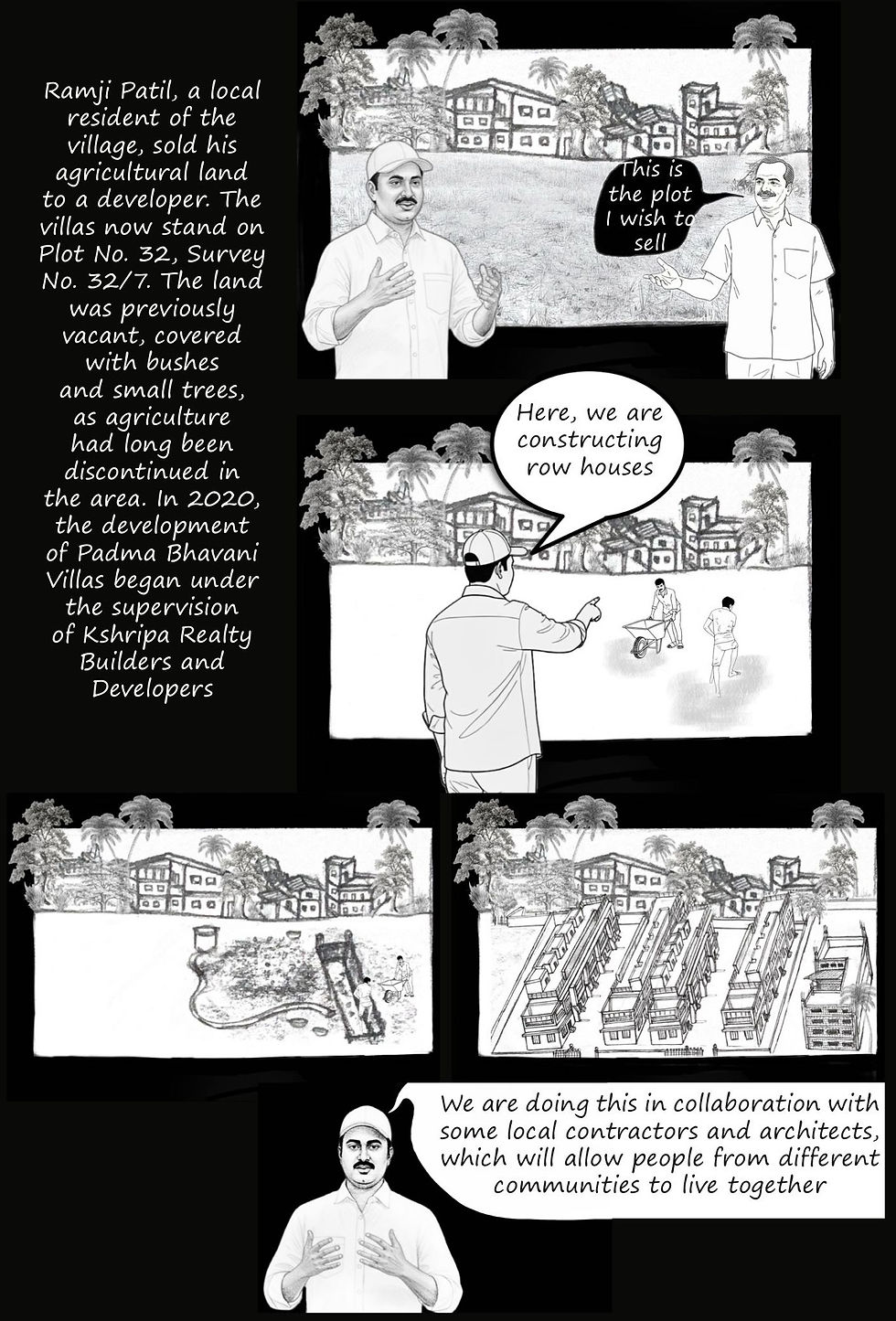
Due to changing aspirations and economic growth, villagers began selling their agricultural land, shifting from a farming based economy to one driven by development and real estate. As agriculture lost its profitability, land became a means of economic advancement, leading developers to introduce new housing typologies such as row houses, apartments, and bungalows, transforming the agrarian landscape into one of residential and economic transition. The Padma Bhavani Villas, developed between 2020 and 2024 by Kshripa Realty on former farmland, spans 3,000 square meters and comprises 20 row houses designed as gated residences, priced between 80 lakhs and 1 crore. These homes, purchased by both locals and residents from nearby cities, reflect the rise of mixed communities and the emergence of gated living within the evolving village landscape.


Case 5 - Migrant Housing as a Financial Model for Temple Organization

In the early 1900s, Padmanabh Swami purchased affordable land in Tembhode, where the Lakshmi Narayan Temple gradually became a key center of social and economic growth for the village. What began as a small community space evolved into a hub supporting local livelihoods through events like the annual Samadhi Mahotsav,which attracted visitors, generated income, and provided rental opportunities for migrant housing. The temple’s expansions in 1970 and 2011 reflected the community’s growing financial capacity, encouraging social gatherings and shifting the agrarian economy toward service-based, migrant-supported, and community-driven activities.


Case 6 - Migrant Housing Rental Model
The Bhaktiniwas, originally built by the temple trustee to house devotees during the annual Mahotsav, has gradually evolved into an affordable housing option and a financial model within the village economy, following a chawl-like pattern with 23 rooms, part of which are now rented to migrant families, reflecting a shift from religious use to income-generating housing. Migrant families like Palak Tiwari’s from Uttar Pradesh have made these rooms their homes, balancing private living with shared community functions during temple events, while local residents have also renovated and vertically expanded their homes, renting upper floors to migrants while retaining the ground level for themselves. These adaptations reveal how affordable housing and incremental construction have become key financial strategies, reshaping the village’s spatial fabric and driving its transition from an agrarian to a service and rent-based economy.


Case 7 - Rise of Contemporary Mid-Rise Residential Buildings
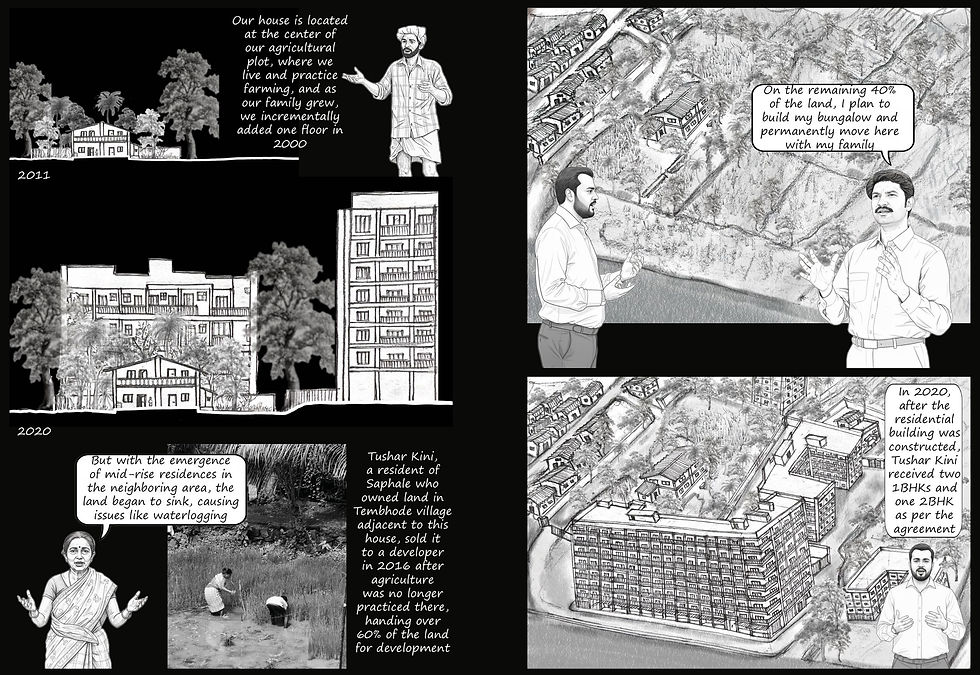
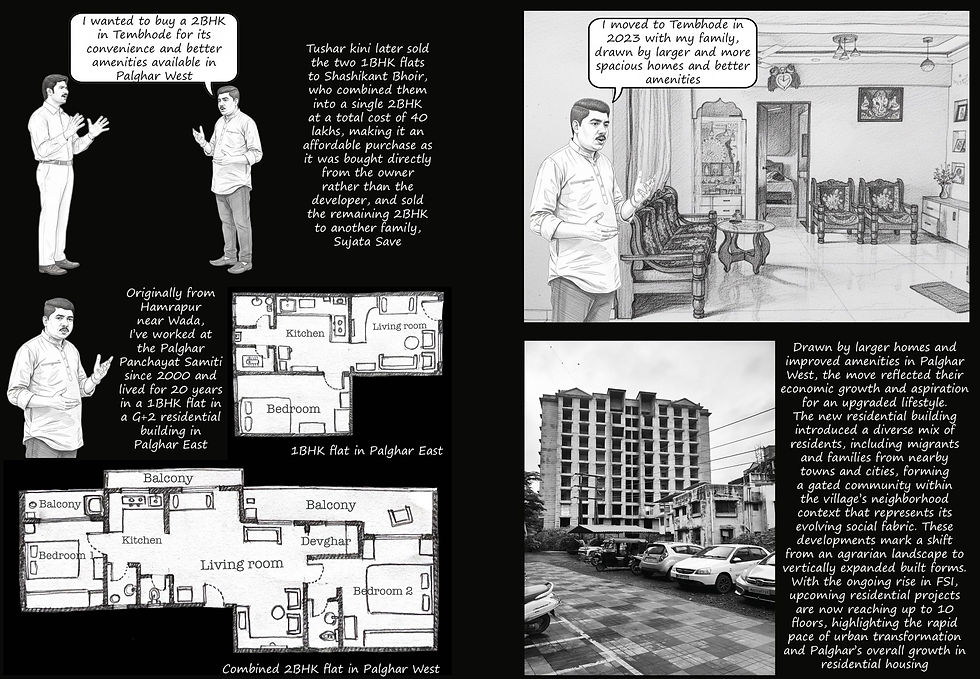
Tushar Kini, a resident of Saphale, sold his unused wadi land in Tembhode to a developer as agriculture was no longer practiced, marking a shift from an agrarian to a real estate-driven economy and reflecting the rise of contemporary mid-rise residential buildings in the area. On 60% of the land, the developer constructed a G+4 residential building in 2020 housing locals, outsiders, and migrants, while Tushar built his own 1 crore bungalow on the remaining 40%. Shashikant Bhoir, a government employee from Palghar East, bought two 1BHK flats from Tushar, combined them into one 2BHK at 40 lakhs, and moved here in 2020 seeking larger space and better amenities, reflecting economic growth and aspiration. This new residential development introduced mixed communities and commercial amenities like supermarkets, medical stores, and general shops, transforming the village landscape and contributing to Palghar’s broader urban and economic growth through new housing forms and increased FSI-based constructions.

FINDINGS AND ANALYSIS
All the supporting narratives of the villagers reflect how their house forms and spatial arrangements have evolved in response to shifting economic conditions, situating these changes within the larger context of Palghar’s transformation. The district has witnessed significant growth in residential and public infrastructure, including the expansion of railways, driven by a rapidly increasing population and the emergence of new urban conditions. These large-scale economic shifts have directly influenced the transformation of domestic spaces, as residents move from agriculture-based livelihoods to salaried and professional employment in sectors such as IT, education, and pharmaceuticals. This transition reflects changing aspirations toward higher education, financial stability, and an improved quality of life, aspirations that are increasingly expressed through the evolving house forms in the village.
The transformation of the agricultural economy is evident in the village’s built fabric, where houses that once supported agrarian livelihoods at an individual household level have adapted over time, moving from shared and communal living arrangements to more private and standardized layouts such as apartment-style homes and vertically expanded structures. These changes align with the larger pattern of urban development in Palghar, where former agricultural lands are being converted into new residential and row-house typologies. The emergence of gated communities, nuclear family housing, and a growing focus on privacy marks a cultural and spatial shift from collective, family-oriented dwellings toward individualized modes of living, reflecting the broader social and economic evolution of the region.
Over time, agricultural land within the village has decreased, becoming a means of economic advancement through real estate development. Many locals have sold portions of their agricultural plots to developers, facilitating the rise of new housing projects. This change has simultaneously created opportunities for migrants from Uttar Pradesh, Madhya Pradesh, and Bihar, who come for employment in contracting, construction, painting, and electrical work, as well as for outsiders from nearby towns such as Boisar, Virar-Vasai, Borivali, and Mumbai, who invest in row houses or bungalows as weekend or secondary homes. The shift toward renting vertically extended local houses to migrants further reflects the changing economy and the growing demand for affordable housing within the village.
As these spatial and economic transitions unfold, the social structure of the village is also changing. Spaces once defined by collective use and open interactions are now being replaced by gated and mixed residential neighborhoods, creating visible physical and social boundaries between local households and new developments. The transformation from compact, agrarian settlements to mid-rise apartments and row houses has reshaped the ecological landscape as well, contributing to challenges such as waterlogging and reduced soil permeability due to intensified construction activity.
Together, the seven narrative studies reveal how economic, social, and ecological transformations are interlinked in shaping the village’s present condition. The shift from agriculture-based livelihoods to service and construction work, the rise of privatized and gated living, and the growing environmental impact of new developments together define the village’s ongoing evolution. These transitions open up possibilities to think of contemporary and sustainable forms of inhabitation that can respond to the changing needs of both local residents and migrants, while addressing the ecological and spatial challenges brought about by Palghar’s rapid urbanization and its growing connection to the metropolitan region of Mumbai.
INFERENCES
Economic Forces Shaping Emerging Urbanism
The emerging urban development is being shaped largely by the villagers themselves, who are creating opportunities for new growth not only at an individual level but also at the scale of the city. As agricultural plots are sold to developers, a shift in economic aspirations becomes evident. Once rooted in agrarian livelihoods, villagers have increasingly turned toward education and employment opportunities such as government jobs, teaching, and contracting. This transition has led many to move away from agricultural practices, selling their land for economic advancement. This process has enabled new forms of development, such as residential buildings by developers and contractors, that now accommodate a mixed community within the village neighborhoods, marking a new emerging pattern in peri-urban transformation.
Incremental Expansion
The change in house types reflects a shift from communal and shared family spaces toward more private, standardized, and gated forms of living. This transformation is not only a response to family expansion but also to the growing desire for privacy and rising aspirations among residents. The typology of residences now includes standardized kitchen and bedroom layouts, unlike earlier partitioned plans where multiple families lived together in shared spaces. This shift is evident in the evolution of house layouts from larger rectangular living rooms with verandahs to designated living and bedroom areas complemented by semi private balconies. The transformation is not limited to spatial form but extends to the materials used in construction. Earlier agrarian houses, typically built with load-bearing mud walls and extensive use of wood for structural support and to create storage or mezzanine spaces like the mala, have gradually evolved toward reinforced frame structures in the incremental expansion of local houses. One of the most significant material shifts can be traced from the use of Mangalore tile roofs in the 1920s to GI sheets during the 1980s driven by market availability and accessibility and eventually to fully concretized built forms. The increasing use of concrete and steel, particularly with the rise of mid-rise residential buildings, replaced local brickwork with concrete blocks, marking a significant transformation in both materiality and house form within the village
Material Transformation
The transformation extends beyond spatial form to the materials used in construction. Earlier agrarian houses were built with load-bearing mud walls and wooden structural elements that also created loft spaces (mala) for storage. Over time, as families incrementally expanded their homes, construction gradually shifted toward reinforced frame structures. A major material transition can be traced from Mangalore tile roofs in the 1920s to GI sheets in the 1980s, driven by changing market availability and maintenance demands and eventually to fully concretized built forms seen today.
REFERENCES
Roth, Robin. 2007. The Challenges of Mapping Complex Indigenous Spatiality: From Abstract Space to Dwelling Space. Department of Geography, York University.
Ahamed, M. F. 2019. “Indigenous Group: A Study through Spatial Perspective.” Journal of Emerging Technologies and Innovative Research (JETIR) 6, no. 3: 475–482. ISSN 2349-5162.
Schmid, Christian, et al. “Towards a New Vocabulary of Urbanisation Processes: A Comparative Approach.” Urban Studies.
Stephens, Carolyn. “The Indigenous Experience of Urbanization.” In The Indigenous World 2015, July 2015. University College London.


Comments